

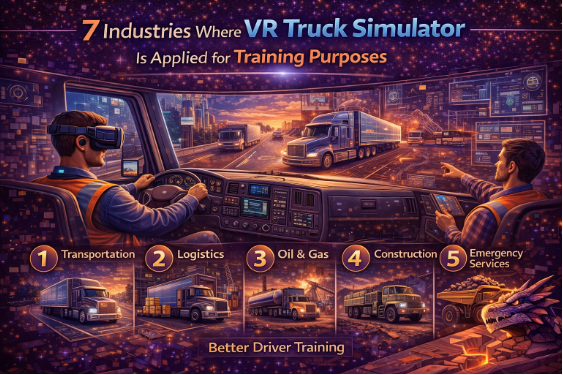

With industries focusing more and more on safety, efficiency, and readiness, conventional training processes are increasingly being supplemented or replaced by immersive technologies. One of the most effective technologies that has come into use in recent times and is being used to a large extent is the VR truck simulator.
The application of VR truck simulator technology is gradually being adopted in logistics and various industries for fast skill acquisition, training, and minimizing operational risks. The following are the seven major industries that this technology is impacting in a significant manner.
1. Logistics and Transportation
The logistics industry was one of the first to embrace the use of VR-based training solutions for drivers. In the face of high turnover rates of qualified drivers, as well as stringent safety standards, the training process has to be efficient and effective.
VR Truck Simulator provides an opportunity for drivers to train on and develop proficiency in the:
- Defensive driving practices
- Urban and highway navigation
- Docking and reversing operations
- Risk awareness in high-traffic situations
By training truckers in a virtual environment before they are unleashed on actual roads, logistics companies are able to reduce accidents and build confidence in new truckers in a shorter period.
2. Freight And Fleet Operations
Large fleet operators have difficulties in ensuring that the skill sets remain consistent for hundreds or thousands of operators. This affects safety as well as the lifespan of vehicles.
VR simulation ensures standardized training for drivers by providing the same conditions for assessment to each driver. Fleet managers can ensure the drivers are trained on:
- Company safety policies
- Handling characteristics of various models of trucks
- Fuel economy driving techniques
Consistency results in good compliance, low maintenance costs, and overall performance.
3. Construction and Infrastructure
Construction sites can be dynamic, complex, and even dangerous. The truck drivers operating in such conditions have to deal with uneven terrain, constraining routes, and construction activity all simultaneously.
VR training enables the operators to train in construction situations in a safe manner in the following ways:
- Construction material transport in restricted environments
- Working near crane and excavator operations
- Handling blind spots and visualization issues
VR Training enables drivers to handle projects on actual construction sites more safely and avoid any potential risks.
4. Mining and Heavy Industry
This is especially true of mining and heavy industries, where some of the largest trucks are deployed worldwide. An error can result in serious damage to equipment or shutdowns.
With the VR truck simulator, operators have the capacity to train for:
- Haul truck functions in extreme territory
- Loading and unloading coordination
- Fatigue and visibility management
Since the costs and risks associated with real-world training in the field of mining are higher, VR simulation provides a cost-effective and safer method for training.
5. Waste Management and Municipal Services
Municipal truck drivers are concerned with operating specialized trucks like refuse trucks, snowplows, or service trucks that function in a residential environment amidst pedestrians and other obstructions.
VR simulation can be used for training in the following:
- Stop-and-go traffic cycles
- Conducting operations on narrow streets
- Awareness of pedestrian and cyclist traffic
- Adverse weather conditions
This increases public safety and also assists cities in training drivers without hindering their activities.
6. Emergency and Utility Services
Utility and emergency vehicles require truck operators who have to act fast under pressure. Whether downed trees have damaged utility infrastructure or infrastructure failures occur due to natural storms, truck operators have to perform under these high-stress operations.
Simulators that use Virtual Reality allow training for:
- Driving in low visibility or during disasters
- Roads with damage
- Working with emergency response personnel
Preparedness is developed through the capacity to rehearse unusual yet important scenarios, without threatening crews or equipment.
7. Driver Training Institutions & Vocational Education
These training schools and vocational institutes are incorporating VR technology into their teaching to equip students effectively in real-life driving situations.
This not only enhances learning outcomes but also makes learning more attractive for current learners, who are accustomed to technology in their learning.
Why VR Simulation Works Across Industries
The adoption of VR trucking simulations in these sectors is mainly dependent on the following benefits:
- Risk-free learning for dangerous scenarios
- Repeatable training without fuel and vehicle costs
- Standardized skill assessment
- Faster Onboarding and Upskilling
When these simulated environments are developed jointly with a professional 3D visualization company, this realism relating to vehicle behavior, surroundings, and engagement is considerably improved. Such realism guarantees a smooth transition from training in VR.
After Training: Data and Performance Analysis
A second big benefit of the simulation afforded through VR technology is the capture of data. The data that is monitored includes:
- Reaction times
- Braking and steering performance
- Hazard Response Accuracy
Conclusion
With industries being pushed for safer, more efficient, and more ready-to-work conditions, immersive technologies for training are being demanded more. The truck simulator in virtual reality has already demonstrated its effectiveness in the realms of logistics, construction, mining, municipal services, and education.
In this way, by offering drivers training in the virtual world with simulated real-world conditions, organizations are able to lessen the risk factors while optimizing performance. When combined with state-of-the-art simulation environments designed by a company specializing in 3D visualization, VR truck simulators are enhanced to be in perfect alignment with performance guidelines.
VR truck simulation has transitioned from an experimental environment within today’s complex industry world to an efficient solution for shaping the future of truck driving safety.