

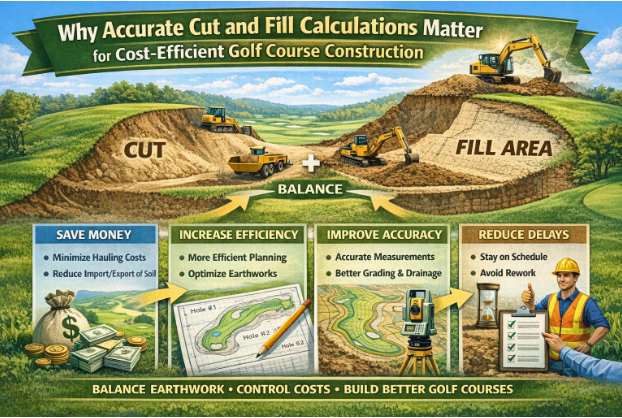

Golf course construction is a very complicated engineering and design process, requiring a confluence of precise planning, careful budgeting, and smart land management. Among the most crucial early tasks are the cut and fill calculations that decide how much soil needs to be excavated and how much is required to be added in order to achieve accurate shaping of fairways, greens, tees, and slopes.
Earthwork often represents the highest costs in any type of golf course development and/or renovation process. Small miscalculations have resulted in significant cost overruns, significant delays, and functional issues on the course. This is the reason why precision in land modeling and measurement is important for the pursuit of efficient project delivery.
Designers will also rely heavily on the detailed earthwork filling calculation methods so that they can correctly anticipate soil movement and plan site grading in a manner balanced with excavation and fill.
A more detailed look follows below as to why accuracy in these calculations plays such an important role in cost-efficient golf course construction.
1. Economical Construction by Balanced Earthwork
This is because earthmoving takes up a big part of the construction budget. The fuel, equipment hours, labor, and transport costs add up in no time. Proper calculation of cut and fill gives a good balance of excavation and fill volumes on site as far as possible.
A balanced grading scheme minimizes:
- Need for hauling soil off-site
- Extra cost of importing filler
- Fuel consumption of earthmoving machinery
- Time wasted in regrading and stabilizing slopes
Earthwork balancing allows courses to make the most use of natural landforms and thus provides economy and environmental friendliness to projects.
2. Proper Course Shaping and Strategic Playability
The shaping of land plays an important part in golf course architecture for the development of playable and aesthetically beautiful holes. Slopes, mounds, landing zones, hazards-all demand perfect grading. One misjudgment during planning will result in ill-shaped fairways, poor drainage, or greens that will not work as intended.
The right approach to earthwork filling lets a designer get landform shaping consistently and correctly; thus:
- Greens are smooth, predictable contours.
- The fairways have just the correct amount of roll and bounce.
- Bunkers really blend in with the landscape.
- The slopes are safe and also allow for strategic playing.
This level of accuracy protects the architect’s design intent while delivering a better player experience.
3. Improvement of Drainage Efficiency and Long-Term Turf Health
Proper drainage is essential in the design of a golf course. Without adequate water movement, fairways become swamps, greens soften, and turf health suffers. Correct grading is, of course, totally dependent upon accurate measurement of soil removals and replacements.
Smarter cut and fill calculation enables designers to create landforms that encourage natural runoff, rather than allowing water to collect in key areas. Good grading helps:
- Eliminate puddling on greens and fairways
- Enhance surface drainage performance
- Reduce erosion of slopes
- Limit demands on expensive subsurface drainage systems
Well-designed grading encourages healthier turf and minimizes long-term maintenance costs.
4. Minimum Disturbance to Land and Soil
Modern construction is all about ecological responsibility. Much excavation destroys the strata of soils, has an impact on vegetation, and raises the possibility of erosion. In that context, proper earthwork filling calculation processes reduce unnecessary land disturbance by the team.
Precise Grading also contributes to environmental goals by:
- Preservation of natural contours whenever possible
- Reduce habitat disruption.
- Lower carbon emissions with heavy machinery
- Minimising unnecessary stockpiles of soil
If well-planned, the courses can be routed around natural ecosystems.
5. Avoiding Construction Delays and On-Site Revisions
Major, often unexpected earthwork issues are quite common. A project that finds it needs more soil, or that it has over-excavated, might find the whole construction schedule shifted as a consequence. And with it come higher costs, extended timelines, and other logistical challenges.
Cut and fill calculations in detail help avoid such situations through the clear roadmap given to earth-moving teams. Contractors know:
- Where cuts must be
- How much material will be needed
- Where the filling should go
- How to maintain a balance in grades
Fewer surprises are the equivalent of smoother construction that stays within budget.
6. Improvement in Collaboration Between Designers and Contractors
Golf course construction involves close collaboration among architects, engineers, and earthmoving contractors. In this regard, it requires effective communication and exactness in calculations to facilitate collaboration.
With advanced digital tools, accurate earthwork filling calculation outputs enable teams to see contour maps, grading layers, and soil movement plans. This ensures everyone interprets the terrain the same way and follows the same specifications.
Improved communication at the site reduces disputes, rework, and misinterpretation.
7. Help in Effective Long-Term Maintenance
Poor grading can result in continuous maintenance problems long after the course opens. Uneven slopes, poor drainage, and shallow soil all add to higher maintenance costs.
Correct cut and fill calculations avoid these three problems by land shaping to support long-term performance. Proper grading leads to:
- Reduced irrigation needs
- Smaller erosion control requirements
- Stable turf root zone
- Smoother mowing patterns
Good earthwork minimizes operational costs and produces a more sustainable golf course.
Conclusion
Precise earthwork planning is key in an industry where not only strategy but also beauty is defined by the shaping of the land. This means that building golf courses can be more efficient, more sustainable, and with a greater degree of confidence in the final result.